Blog · 24 November 2026
Three Days at Mundaka: Huge Waves and a Few Improvements to Reeve
By Guillaume Hamez, founder of Reeve
I’d wanted to surf Mundaka in big conditions for a while. Not just when the wave is working, but when it becomes exceptional.
For that, several things have to line up: a big northwest swell, a long period, the right wind and a good tide. You mostly get that in fall and winter, when the Atlantic storms come one after another.
For weeks I’d been checking the forecasts, hoping for a window of a few days when everything would come together. I live two hours’ drive away, so I wanted the trip to be worth it. But nothing came. The waves were either too small, or too big with the wrong wind, or the period was too short.
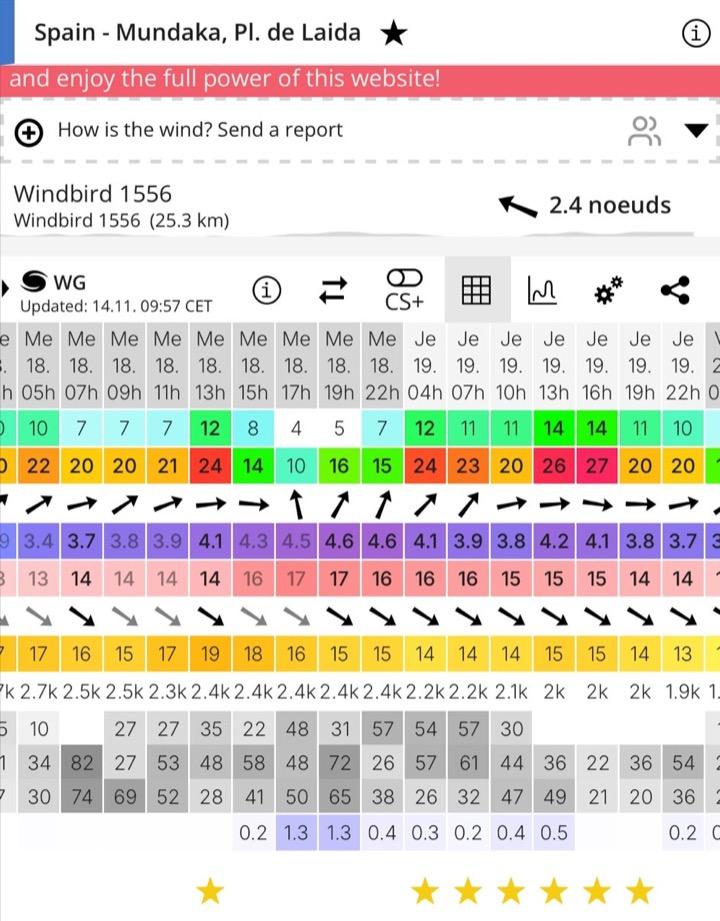
Then, in mid-November, a window finally started to take shape. Four meters of swell, a 15-second period and a strong west-southwest wind. On Windguru everything was purple, and the numbers were huge. Usually, when you see a forecast like that, you look for somewhere else to be.
I even started to wonder if it would be too big. But the days off were taken and the apartment was booked. Turning back wasn’t an option anymore. All we could do was hope the forecast would move the right way.
Had we been a bit greedy?
Day one: arriving in Mundaka
We arrived on Tuesday afternoon. The swell hadn’t come in yet and the village was quiet, so we settled in and got reacquainted with the area.
Our Airbnb had an incredible view of the sea, right over the last section of the Mundaka wave. A few surfers were out in 50 cm to 1 m waves.
I’d brought my gear to film with Reeve, the app I’ve been building for several months to record surfers’ waves automatically. I set it up in the apartment, just to see if detection worked from that distance. Bingo, it worked.
And I quickly realized it was almost the ideal setup. We were at the right distance to film, the gear was safe indoors, and there was even a socket next to it to keep the iPhone plugged in and filming nonstop.
The only problem: from there, we couldn’t see the start of the wave at all. So for the next day, it wouldn’t be much use. But that little test gave me an idea.
If people own an apartment, a house or a plot of land overlooking a surf spot, why not set Reeve up there for good? Sessions could be filmed automatically, without anyone having to set up and watch the gear every day.
It’s worth exploring. If you run a surf school with a hut on the beach, or simply own a property that looks onto a spot, I think we should talk!
Day two: the swell starts to fill in
Alarm at 6:30. Still pitch dark. You could feel the excitement building with my two partners in crime. When we opened the windows we could hear the sea roaring, and barely make out a few white shapes in the dark.
Off to the spot. As the day broke, the first lines started to show. The verdict: the swell hadn’t fully filled in yet. It was 1 to 1.5 m, with a bit too much water.
I’d also had doubts about the small tides in the forecast. Sure enough, the tide was already too high, and still rising. The wave wasn’t hollow enough. It was surfable, there were even a few good waves, but I preferred to save myself for the afternoon and the dropping tide.
My two friends went for it. There were barely five of them out, which is rare at Mundaka, and they got a few good waves. During their session, the swell kept building.
Meanwhile, I sat in a café, imagining what the afternoon had in store for me. And above all the next day. The buoy was already reading more than 2.5 m and about 1.5 kJ of energy. The forecast called for more than 10 kJ in the afternoon. I was seriously starting to wonder what kind of beating I was in for.
Around me, a few locals were quietly reading the paper over their coffee. Except one, who had already ordered a beer. It wasn’t even eight o’clock. Maybe I should do the same before the afternoon.
The first real session
It was 3 pm. I’d had my nap. I was ready.
The waves had grown a lot since the morning, but they still looked manageable. About ten people were out. I paddled out for a session of more than three hours.
I got a few very good waves, some with rides of more than 100 meters. When you catch the right one, you can surf for a long time. Still no barrels, though. With the small tides, the wave wasn’t hollow enough.
But it felt good. My two buddies were out too, and got some nice waves. Since all three of us were in the water, we’d decided not to set up Reeve. Nobody could keep an eye on the gear.
We finished that first real day of surfing very happy. But the biggest swell was forecast for the next day.
Day three: the big day
The wind blew all night. The shutters banged and the wind whistled. Hard to sleep through all that racket, especially knowing what was waiting for us. Up at 7, after a far less restful night than the one before.
We went back to the esplanade above the spot. In the first light, we started to make out enormous walls of water. The wind was blowing hard offshore. Out by the island off Mundaka, monstrous waves were exploding against the cliffs.
It was big. Seriously big. We laughed nervously.
We spent a good half hour watching. With every new set, we checked whether the next wave would be even bigger than the last. It was hard to judge the size, because nobody was out yet.
What surprised me was that despite their size, the waves didn’t look particularly hollow at the takeoff. They started as a big, fairly flat mass of water, then sped up and began to hollow out as they moved over the sandbank. That day, the barrel section was further down the wave, not really at the peak.
My two friends chose to sit this one out. I decided to go. After all, that’s what I’d come for.
In the water
There were about fifteen of us in the lineup. At least the weather was nice. The temperature was even pleasant for November.
Once I reached the peak, I caught a wave fairly quickly, with a small but committed drop. That gave me confidence for the rest of the session. The waves were huge, but strangely, I didn’t feel much fear. I felt good in the water.
I watched the locals, who sat much deeper and went earlier than me. Some of them caught impressive waves.
Several times, I scraped over the shoulder and watched huge barrels roll past right next to me. You could have fit two people standing up inside them. I was mesmerized by the power and beauty of the moment.
The wind was still blowing just as hard. Every time we went over a wave, we got a shower of spray right in the face. You had to keep paddling, repositioning, staying balanced. Between the effort, the incoming sets and the constant repositioning, the session was intense even when you weren’t surfing.
A wave I’ll remember
At one point, a set came in. The other surfers were sitting too deep. I was in a good spot. I turned and started paddling.
As I took off, the offshore wind threw so much water in my face that I could hardly see where I was going. I still managed to get in and get to my feet. The sun was right in my line, which didn’t help.
But I made the drop, went down the face and kept picking up speed. My fins started to whistle. It reminded me of the sound a Hobie Cat’s rudders make when you’re flying. I ran down the line and sped up again.
A barrel section came. I tried to set up inside it and stay under the lip for a few seconds. But I ended up getting flipped and thrown off my board.
Oh well. Not this time.
Over the session, I made several good drops and caught a few good waves. Unfortunately, I never made it out of a barrel. Some sets were so big they cleaned out the whole lineup. Several surfers had to go in and come back around through the river channel to get back to the peak.
When I finally got out of the water, I was exhausted. But happy.
And Reeve?
For this last session, we’d decided to set up Reeve. One of my friends, who wasn’t surfing, could stay on land and watch the tripod.
Even with the camera a long way from the surfers, Reeve filmed several good waves, with fairly good image quality. And all of it with just my iPhone, no add-on telephoto lens.
But that day’s conditions also exposed one of the app’s limits.
At 5×, the surfers were sometimes too small in the frame to be detected reliably. At 10×, detection worked much better, but the field of view became much narrower.
In that version of Reeve, I couldn’t yet pick a zoom between 5× and 10×. So I stayed at 10×, to make sure surfers were detected as they came into the frame. The trade-off: with such a tight frame, a lot of waves went past the camera and never got filmed.
So it’s one of the first things I fixed after that session. You can now adjust the zoom gradually to find the right balance between detection and field of view. A fairly simple change, but it matters: you can keep the frame wide enough to cover the different sections of the wave and still detect the surfers reliably.
The barrel problem
Another problem I ran into: watching the videos back, I noticed something frustrating. Some surfers got beautiful barrels, but the moment they disappeared behind the lip, Reeve of course couldn’t detect them anymore. The gimbal then stopped following the surfer, and the recording ended one second after detection was lost.
In other words, Reeve sometimes cut the video at the exact moment the wave got interesting. Not great for an app that’s supposed to film surfing automatically.
So I made a first fix. Now, when the surfer disappears, the gimbal can keep following their path for several seconds (a setting you can adjust in the app), estimating where they’re going from their speed just before detection was lost. The idea is simple: if a surfer disappears into a barrel, the camera keeps following the wave instead of stopping straight away.
I ran a few tests in the afternoon, and among other things, this change let Reeve properly film a surfer getting barreled.
There’s still work to do, but this trip at least helped me pin down two concrete problems I’d never run into like this in my usual sessions.
The last word
I came home from Mundaka completely wiped out, without having made it out of a barrel, but with a few waves I’ll remember for a long time. The conditions were incredible and I’m glad I went for it, even if, looking at the forecast a few days earlier, I’d wondered whether we’d bitten off more than we could chew.
As for Reeve, the trip turned out to be useful too. Between the zoom and tracking surfers into the barrel, I had plenty to keep me busy back home. And the improvements I talk about here are already in the latest version of the app!
More improvements are already in the works, so if you want to follow how Reeve evolves, find me on Instagram @reeve_surf. Stay tuned!